One of the recommendations made in a recent Bay of Plenty Regional Council case study of our predator control efforts was to introduce a vegetation monitoring project to measure our forest health and diversity over time — specifically the impact of browsing predators (possum, deer & pigs).
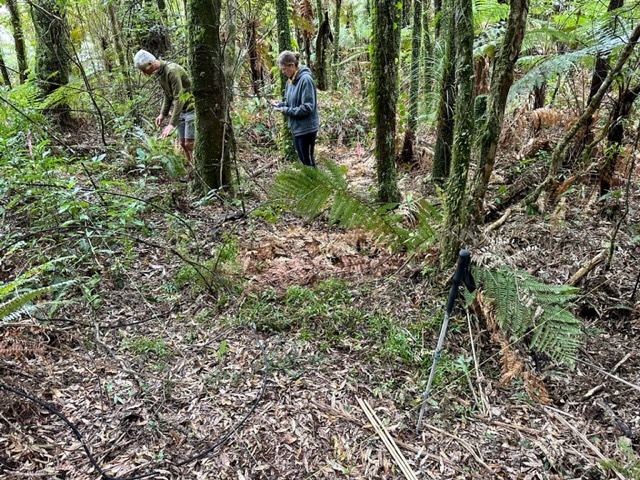
Two of our botanical enthusiasts Mike Tills and Philippa Howcroft attended a Bay Conservation Alliance training day back in March, and last Saturday — 7 October — established the first phase of this project by identifying two sampling areas, 5 metres x 5 metres of ‘representative vegetation’ (not swamp/wetland or fern groves, for example) locating one area within our trapping domain and the other comfortably outside.
The count required any plant between 30cm and 200cm tall be identified and counted. Both Mike and Philippa were very impressed with the overall diversity and health of vegetation within the general Friends of the Blade domain, with a large number of healthy seedlings visible throughout.
This indicates that both rats and browsing animals are under control, so we should all be very proud of that achievement. Eight different native species (51 total) of requisite size were identified in plot 1 and 13 (52 total) in plot 2. Of particular note was the prevalence of numerous ‘recruitment’ trees, that is, the next generation of significant trees such as tawa, miro and rimu. Stage two will be to return to these plots in 12 months’ time for a comparative count.
 Friends of the Blade